HISTORY
Cigar City — when Key West rolled a hundred million cigars a year
In 1885 Key West was the largest city in Florida, richer per capita than Chicago, and the cigar capital of the world. Two hundred factories, ten thousand Cuban rollers, and a hundred million cigars a year. Then Tampa poached the industry in one decade.
If you'd stood on Duval Street in 1885, Key West would not have looked like a resort town. It would have looked like Havana's twin. Cuban Spanish on every corner. Two hundred cigar factories running six days a week. Rows of clapboard boarding houses filled with tabaqueros — cigar rollers — who'd come across the Straits of Florida from a Cuban war.
The cigar industry landed in Key West in 1831, but it didn't scale until the Ten Years' War (1868-1878) drove Cuban patriots and cigar-industry money out of Havana. Vicente Martínez Ybor moved his factory from Havana to Key West in 1869. Others followed. By the 1880s, Key West had roughly 100 factories at peak, then more than 200 at the industry's high water mark. Between 1875 and 1885, the population tripled to nearly 20,000 — making it the largest city in Florida, ahead of Tampa, Jacksonville, and Pensacola.
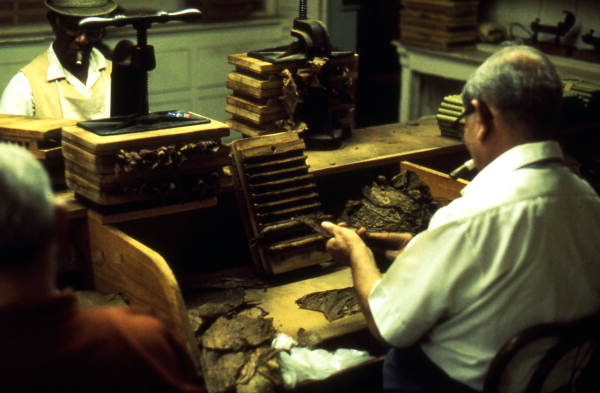
Every cigar was rolled by hand. A skilled tabaquero could produce 200 to 250 cigars a day. Key West at peak was rolling somewhere north of 100 million cigars a year, most of them shipped north through steamship lines to New York, Philadelphia, and Chicago. Every 'clear Havana' cigar in America was probably rolled on a wooden bench on this island by a Cuban immigrant.
There's a specific detail about the factories that people forget: they had readers. El lector. A man paid by the workers themselves — not by the factory — would sit on a raised platform and read to them for the whole shift. Newspapers in the morning, novels in the afternoon. Don Quixote, Les Misérables, political pamphlets from Havana, Hugo, Zola. A cigar factory floor in Key West in 1885 was one of the most literate workplaces in America. Workers who couldn't read English or Spanish knew Tolstoy from six hours a day of hearing him.
This is also how the Cuban independence movement funded itself. José Martí — the poet, the revolutionary, the man on the Cuban peso — visited Key West at least seven times between 1891 and 1894. He gave speeches at the San Carlos Institute on Duval Street (still standing at 516 Duval). Cigar workers voluntarily gave 10 percent of their weekly wages to the Cuban Revolutionary Party. The 1895 uprising that led to Cuban independence was substantially funded by Key West cigar money.
What broke it: in 1885, the Ybor family — the same Vicente Martínez Ybor who'd started the local boom — moved his operation to Tampa. Cheaper land, better rail access to the American market, and, critically, no union strikes. Key West cigar workers had organized. Tampa recruited scabs. Between 1885 and 1900, most of the major factories relocated. The 1886 great Key West fire, which burned 50 acres of downtown, sped things up. By 1910, Tampa was the cigar capital and Key West was in a 40-year economic decline that lasted through the Depression.
The buildings are still here. The Gato Cigar Factory on Simonton Street is now condos. The San Carlos Institute is a museum. The old wooden boarding houses on Bahama Village and along the streets south of Truman Avenue are the same ones the tabaqueros lived in — many still owned by descendants of the original Cuban families. If you take the Old Town walking tour and pay attention to the small plaques, half the buildings you'll pass had a factory or boarding house use in the cigar era.
The Cuban heritage on the island is not a theme. It's the actual foundation. The Latin food you're eating in Bahama Village, the annual festivals, the family names — Roberts, Diaz, Falto, Perez, de la Torre — are the direct line back to 1885 when this island rolled cigars for the world.
Book This Kind Of Day
Want to go see it for yourself?
Local operators, booked on their own secure checkout.
See our Key West tips and event updates more often when you search Google.


